① The Problem
After Heart Surgery, Patients Are Left on Their Own — and Many Fail
Coronary artery bypass graft surgery (CABGS) is one of the most common major cardiac procedures
worldwide, performed to restore blood flow and improve quality of life. Yet surgery alone is not
enough. Long-term outcomes depend entirely on whether patients adhere to their
post-operative regimen — the right diet, daily movement, and strict medication use.
Studies consistently show that inadequate or ineffective patient education is
the primary driver of non-adherence, leading to preventable complications and readmissions.
Surgical Rebound Risk
0%
of CABG complications are linked to poor adherence to therapeutic regimen post-discharge
Why Patients Don't Adhere
Root causes of therapeutic non-compliance post-CABGS
Ineffective Training Methods68%
Lack of Ongoing Reinforcement72%
📉 Adherence Decline After Cardiac Surgery (Schematic Trajectory)
🏥
CABG Surgery
Restores circulation; success depends on what comes next
📋
Regimen Prescribed
Diet, medications, and movement plan issued at discharge
⚠️
Non-Adherence
Poor training leads to misunderstanding and dropout
🔁
Readmission
Preventable complications, infection, rehospitalization
② The Trial Design
123 CABG Patients, Block-Randomized, 30-Day Follow-Up
This randomized clinical trial enrolled CABG patients admitted to Tehran
University of Medical Sciences hospitals in 2019. Eligible patients (ages 18–60, Android
phone owners, Persian-speaking) were allocated using block randomization (size 4)
into three equal groups: gamification app, teach-back, and usual-care control.
All outcomes were measured before and 30 days post-discharge via in-home visits.
123
Enrolled CABG patients · 3 arms · Tehran hospitals · 2019
41
Patients per arm (equal allocation)
~65%
Male across groups (balanced)
30d
Post-discharge assessment window
0.82
MMAS Cronbach's α (reliability)
Demographic Balance Across Groups
🎮
Gamification (n=41)
Delban app installed at discharge; animated modules, star rewards, leaderboard
↔
🗣️
Teach-Back (n=41)
45–60 min individual session; patient repeats key points; booklet provided
↔
📋
Control (n=41)
Routine ward nurse training only; no researcher intervention
Adherence measured by two validated instruments: the Sanaie et al. questionnaire (dietary: 30 items, 4-pt Likert; movement: 19 items, 5-pt Likert) and the MMAS medication adherence scale (7 yes/no + 1 Likert, score ≥6 = desired). All scores normalized for cross-domain comparison via one-way ANOVA + Dunnett post-hoc test.
③ The Interventions
"Delban" — A Heart-Protecting Game vs. Teach-Back vs. Usual Care
The study tested three real-world training approaches head-to-head. The centerpiece is
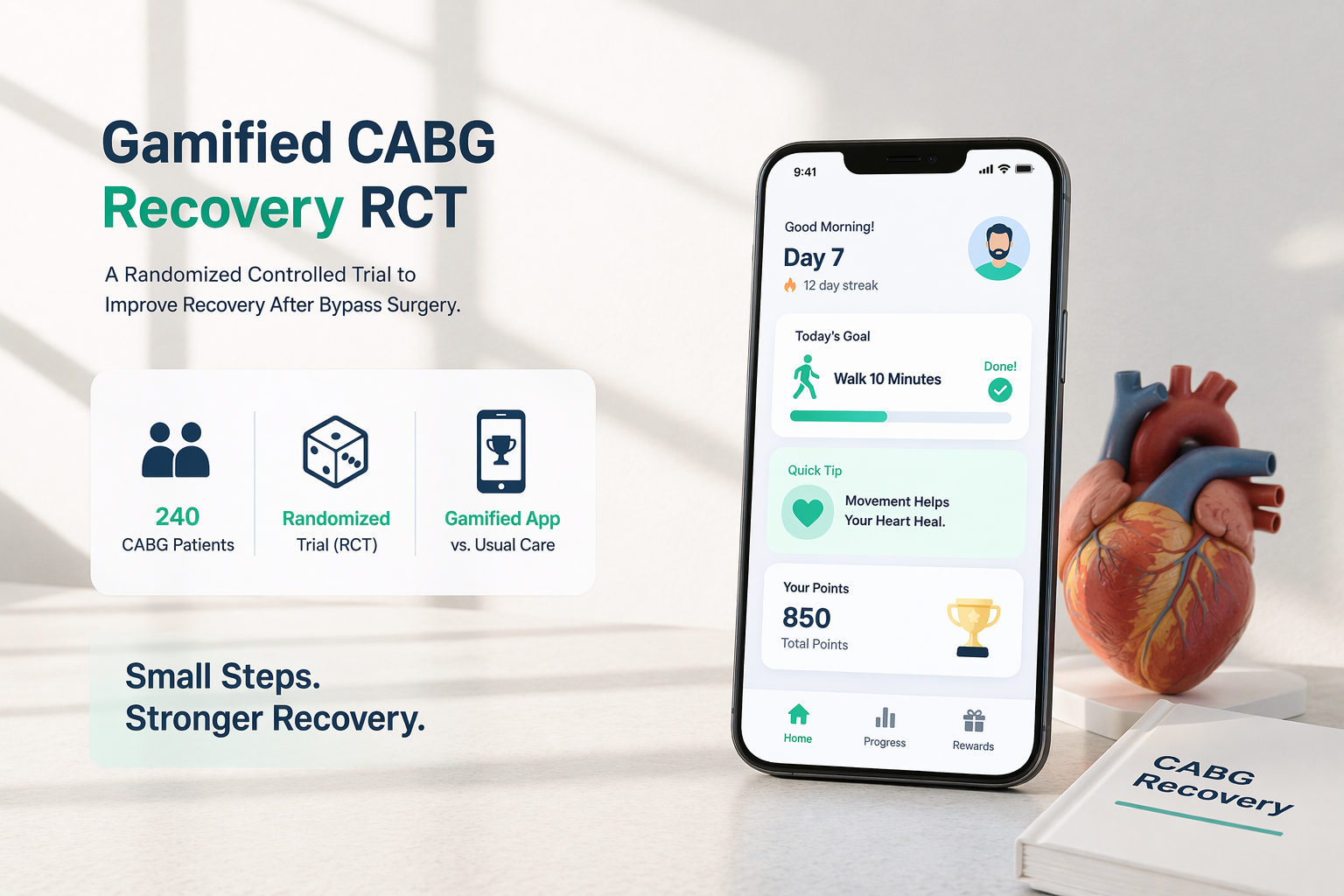
Delban (Persian for "heart protector") — a custom-built Android application
that wraps evidence-based cardiac education in game mechanics: rewards, punishments, leaderboards,
and animated content across three clinical modules.
📋
Usual Care (Control)
Standard ward nurse verbal briefing. No structured content, no repetition, no follow-up mechanism. Represents the current baseline in most Iranian hospitals.
⚠ Existing Standard
🔁
Teach-Back Method
Researcher delivers 45–60 min individual session in plain language. Patient recites key points back; misunderstandings corrected. Booklet provided for 30-day reference.
✓ Evidence-Based Direct
🎮
Gamification (Delban App)
App installed on patient's Android phone at discharge. Three modules (diet, medication, movement) with animated content, assessments, star rewards (±6/3), and a shared leaderboard.
🚀 Novel Digital Approach
📱 Delban App Feature Breakdown
🥗
Diet Module
7 food groups: cereals, meat, dairy, fruits, vegetables, fat, general recs
💊
Medication Module
β-blockers, antiplatelets, statins, diuretics, anticoagulants — all covered
🚶
Movement Module
Walking, spirometer, breathing, 4-week cardiac rehab exercises, return to work
⭐
Gamification Layer
+6 stars correct / –3 stars wrong; screen fills with stars; social leaderboard
🏥
Enrollment
CABG patients meeting criteria recruited from Tehran TUMS ICUs in 2019.
🎲
Randomization
Block randomization (size 4) → equal groups of 41. Pretest questionnaires completed.
📱
Intervention
App installed (gamification) / session delivered (teach-back) / ward only (control).
🏠
Follow-Up
30-day in-home visit. Validated questionnaires re-administered. ANOVA + Dunnett test.
① Eligibility
- Age 18–60 years
- Owns Android phone
- Speaks Persian fluently
- No psychotropic drugs
- No hearing/speech issues
② Instruments
- Sanaie dietary questionnaire (30 items)
- Sanaie movement scale (19 items)
- MMAS medication scale
- Cronbach α = .81–.82
③ Outcomes
- Dietary adherence score
- Movement/physical activity score
- Medication adherence score
- Pre vs. 30-day post comparison
④ Statistics
- SPSS v20 + STATA v12
- One-way ANOVA (3 groups)
- Dunnett post-hoc vs. control
- Fisher exact, chi-square, t-test
④ Results
Gamification Wins on Diet and Movement — Medication Is a Draw
One-way ANOVA confirmed highly significant differences across all three adherence domains.
Dunnett post-hoc tests showed both interventions outperform usual care for
diet and movement. Critically, the gamification app significantly outperformed
teach-back on dietary (non-overlapping CIs) and movement adherence — the first
such head-to-head confirmation in a post-CABG population. Medication adherence showed
no significant difference between the two active interventions.
F=124.5
Movement regimen ANOVA F-statistic (p<.001)
Gamification Δ = +2.013 vs. control
F=71.8
Diet regimen ANOVA F-statistic (p<.001)
Gamification Δ = +1.797 vs. control
F=9.66
Medication regimen ANOVA F-statistic (p<.001)
Both groups vs. control; no diff between active arms
Mean Normalized Adherence Scores by Group and Regimen Domain
Dunnett Test: Mean Difference vs. Control (95% CI) — Non-overlap = Significant Difference Between Active Arms
🎯
Why Gamification Outperforms Teach-Back for Behavior Change
The Delban app succeeds because it addresses the core weaknesses of teach-back: repetition at any time, anywhere; intrinsic motivation through star rewards; and social accountability via a shared leaderboard. Medication adherence is a different cognitive task — patients already have reminders built into pill schedules — which explains why both active methods converge there. The CI non-overlap for diet and movement is the statistical smoking gun: this isn't noise, it's a genuine behavioral advantage of interactive game-based learning.
⑤ Takeaways
What This Means for Digital Health and Patient Education
01
Games Motivate Where Lectures Don't
Gamification's advantages — repeat access, star rewards, and leaderboard-driven social comparison — address exactly the failures of time-limited bedside teaching for habitual behaviors like diet and exercise.
02
Behavioral vs. Cognitive Adherence
Medication taking is cognitively simple (take pill at set time). Diet and movement require sustained behavioral change — precisely where gamification's feedback loops provide the most marginal uplift.
03
mHealth Is Ready for Cardiac Wards
With smartphone ownership near-universal and Android penetration high in Iran, this model is immediately deployable at scale. The investment: one app install at discharge. The return: measurable adherence gains at 30 days.
04
Future: Interactivity + Reminders
The study's own limitations point to the next iteration: push reminders, usage logging, and family member integration. A version 2.0 Delban with these features could close even the medication gap.